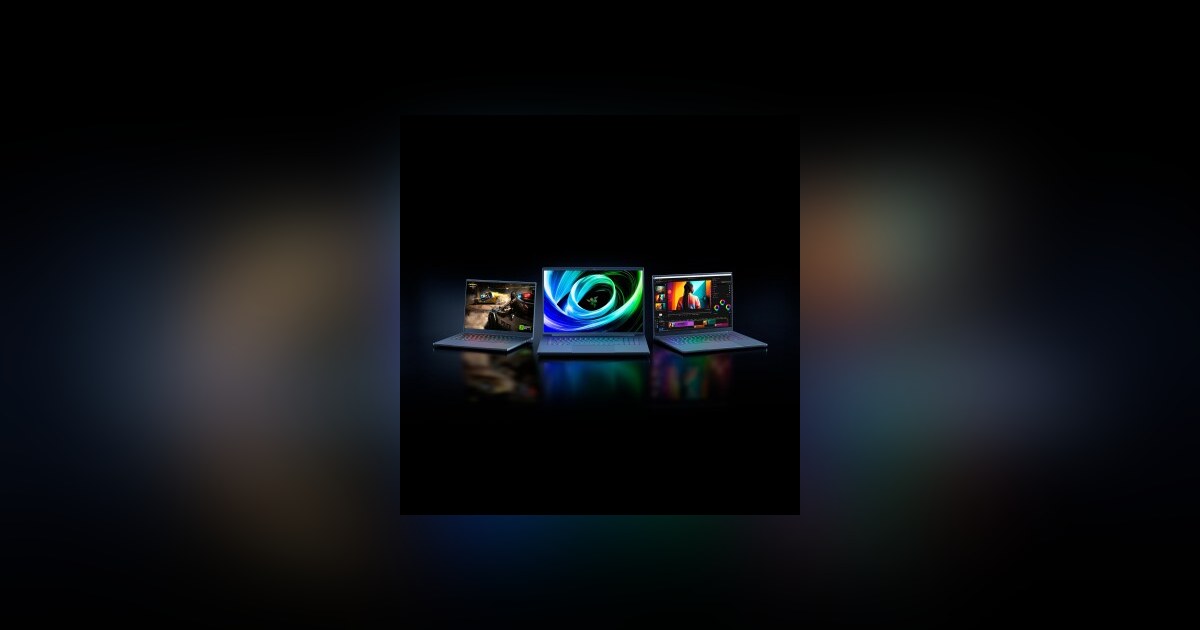
Razer has unveiled its 2026 Blade laptop lineup, comprising the Blade 14, Blade 16, and Blade 18, each engineered for specific use cases ranging from ultra-portable gaming to desktop-replacement performance. The announcement, made via a press release, highlights key differences in graphics, processors, memory, display, and weight, allowing users to choose based on their priorities for portability versus raw power.
The Blade 14, starting at $2,299, is the lightest at 1.63 kg and features up to an NVIDIA GeForce RTX 5070 (115W TGP) and an AMD Ryzen AI 9 365 processor. It targets gamers on the move, offering a 14-inch QHD+ OLED display at 120 Hz and a 72 Wh battery for all-day use. This model is ideal for students, commuters, and frequent travelers who need serious GPU power without sacrificing portability.
The Blade 16, priced from $2,399 to $5,599, balances performance and portability at 2.14 kg and 14.9 mm thin. It can be configured with up to an RTX 5090 (165W TGP) and AMD Ryzen AI 9 HX 370, along with up to 64 GB of LPDDR5X-9600 MHz memory. Its 16-inch QHD+ OLED display at 240 Hz with VESA TrueBlack 1000 HDR makes it suitable for both competitive gaming and content creation. Thunderbolt 5 connectivity allows easy integration with desktop setups.
The Blade 18, starting at $3,499, is the flagship model for power users. It weighs 3.10 kg and features up to an RTX 5090 (175W TGP) with an Intel Core Ultra 9 290HX Plus (24 cores). It is the only model with slotted DDR5 RAM (up to 128 GB) and dual M.2 NVMe slots (up to 8 TB), offering upgradeability for AI training, 4K rendering, and large game libraries. Its 18-inch display comes in UHD+ 240 Hz or FHD+ 440 Hz options, and triple-fan vapor chamber cooling sustains performance under heavy workloads.
All models feature Razer's anodised aluminium unibody and vapor chamber cooling. The Blade 14 and 16 use AMD processors with integrated NPUs up to 50 TOPS for AI workloads, while the Blade 18 relies on Intel's NPU. The Blade 18 also supports overclocking via Razer Synapse.
This lineup underscores Razer's strategy to cater to diverse segments: the Blade 14 for ultraportable gaming, the Blade 16 as a versatile all-rounder, and the Blade 18 for those who demand desktop-class performance in a laptop. For creators and AI developers, the Blade 18's expandable memory and storage are critical. For gamers prioritizing battery life and weight, the Blade 14 offers a compelling option.
For more details, visit the Razer Blade 14, Razer Blade 16, and Razer Blade 18 pages.