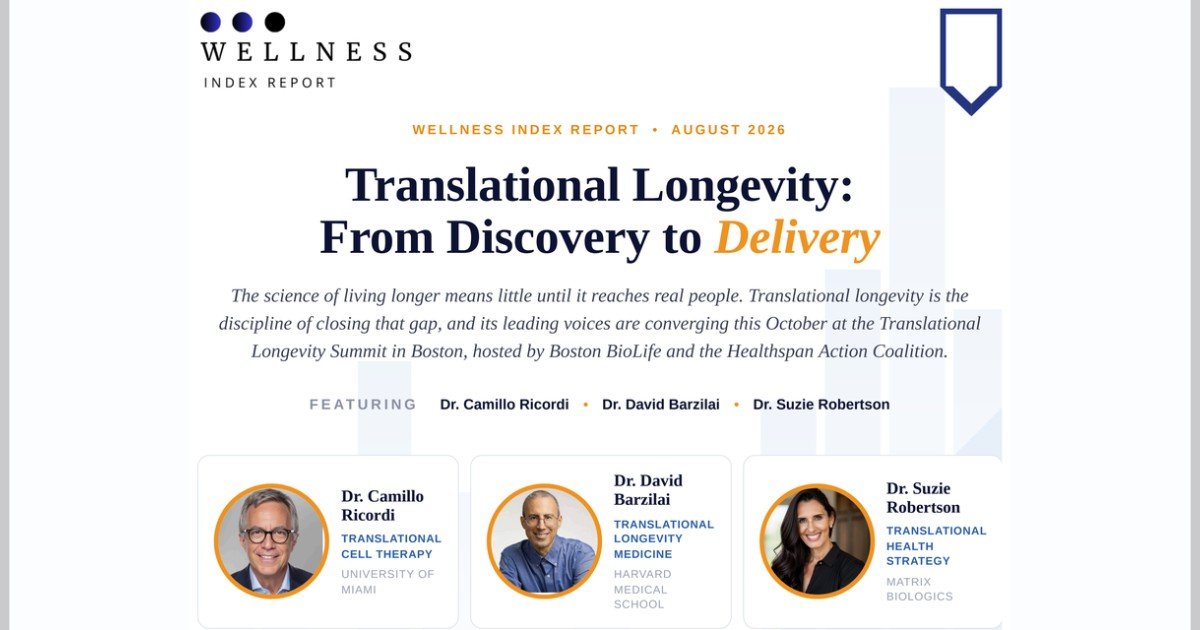
The field of longevity science is at a pivotal juncture: the gap between laboratory discoveries and patient care is where the promise of extended healthspan is either fulfilled or lost. According to the August Wellness Index Report from Wellness Eternal, the discipline of translational longevity is the key to closing this divide. The report, released ahead of the Translational Longevity Summit in Boston, underscores that progress in aging research is meaningless unless it reaches the people who need it most.
The report identifies three critical signals driving the shift from discovery to delivery. The first is the transition of cell science from proof of concept to real-world clinical application. After decades of research, transplantation and cell therapy are moving beyond specialized centers and into mainstream longevity medicine, with an emphasis on reversing the drivers of disease rather than merely managing symptoms. The second signal is the growing importance of evidence as the bridge between research and practice. As the market becomes saturated with longevity claims, the ability to distinguish what is scientifically proven from what is speculative has become invaluable for clinicians, executives, and policymakers. The third signal is the necessity of clinical strategy and systems to scale care effectively. Even the most promising therapies fail if healthcare systems cannot deliver them safely and consistently, making operational rigor and innovative care models essential.
The report features three experts who embody these signals. Dr. Camillo Ricordi, a professor at the University of Miami, anchors the first signal with his pioneering work in translational cell therapy. Dr. David Barzilai, a Harvard Medical School lecturer and longevity medicine physician, represents the second signal, known for making complex science accessible and actionable. Dr. Suzie Robertson, a clinical pharmacist and healthcare strategist, exemplifies the third signal, bridging clinical excellence with innovation to improve patient safety and care delivery.
These voices will converge at the Translational Longevity Summit, hosted by Joseph Krieger of Boston BioLife and Bernard Siegel of the Healthspan Action Coalition, from October 7 to 11 at the Harvard Enterprise Research Campus. The summit aims to accelerate the integration of cutting-edge longevity science into everyday practice, uniting discovery with delivery.
The Wellness Index Report applies a rigorous four-step verification process, including expert nomination, patient feedback, clinical review, and performance tracking, to ensure that featured solutions meet an integrity-first standard. Lindsay O'Neill-O'Keefe, founder of Wellness Eternal, emphasized, "The future of longevity is translational. The breakthroughs are real, but they only matter when they reach people."
As the field evolves, the August report serves as a call to action for the industry to focus not just on discovery but on the systems and strategies that will bring longevity science to the bedside. The full report is available at wellnessindexreport.com.